
Top-level international university with a focus on research
UTAMED is a university with a clear focus on research and seeks to position itself as a top-level international research centre. UTAMED's research activity is inspired by these axes:
Encouraging research through incentives, mentorship, positive evaluation of research activity, and support for faculty accreditation.
Establishing strategic priorities that generate social and economic impact at the regional, national, and international levels, while also supporting the University's inclusion in national and international rankings.
Developing synergies and joint research programs with knowledge partners, along with cooperation with business and social organizations and the integration of research into the Andalusian and national economy.

Training researchers, supporting their integration into research groups, and recruiting talent both nationally and internationally.

Securing funding through competitive calls that contributes to research excellence at UTAMED.

Building high-level research infrastructure and fostering a culture of scientific integrity.

Research at UTAMED
Research at UTAMED University is carried out through its Institutional Research and Knowledge Transfer Plan, known as the Strategic Plan for Research Excellence. The plan promotes high-quality research grounded in best practices and designed to continually strengthen the university's research activity. Through this model, UTAMED invests in innovation, the training of researchers, and the development of projects capable of generating social, economic, and academic impact. The Institutional Research Plan currently comprises seven research support programs.
UTAMED University's research strategy is growing steadily and is closely tied to its degree programs, its fields of study, and its relationship with the business and social community. This allows the university to launch new research groups, develop competitive projects, and collaborate with public and private institutions.

Research model
Our research model rests on four core pillars: excellence, knowledge transfer, talent, and internationalization. We are committed to applied, results-oriented research that responds to real-world needs and contributes to knowledge, innovation, and competitiveness.
To make this model possible, the Department of Research and Knowledge Transfer Support (DAIT, Spanish acronym), which reports to UTAMED University's Vice Rectorate for Research, Knowledge Transfer, and Institutional Relations, works alongside researchers and provides the resources, guidance, and technical support they need to carry out their work while reducing the administrative burden. This support is essential to strengthening project funding, scientific output, and institutional visibility.

Lines of research
UTAMED University pursues research connected to the principal challenges facing society today. This work takes place in fields including Law, Education, Communication and Marketing, Business and Economics, Nutrition, Computer Science, Engineering, and Psychology.
Within these fields, the main lines of research are:
- Digital economy, data analysis, digitisation of the economy and business.
- The knowledge economy and information society.
- Health economy.
- Educational technologies.
- Digital ethics.
- Connection between physical health and mental health.
- Digital marketing.
- Artificial intelligence and its applications.
- Social sciences in the context of the digital economy/society
- Digital law and data protection.
- Journalism and communication in the context of the digital society.
- Nutrition
- Psychology
- Technology and Multimedia Production

Research groups
Research groups are a fundamental part of UTAMED University's scientific activity. Their development is intended to foster collaboration among researchers, strengthen priority research areas, and contribute to the growth of the university's scientific output.
These groups drive the creation of knowledge, high-quality scientific production, and the transfer of results through collaboration between senior researchers and early-career profiles, supporting mentorship and academic development. In an initial phase, they are organized by field of study and may include external collaborators, with the possibility of evolving into more specialized structures. Groups with outstanding performance may be incorporated into units of excellence, gaining greater institutional support, visibility, and capacity to secure competitive funding.
UTAMED University is currently designing the research groups that will be affiliated with the institution, and to that end we have launched our first call for Research Groups. If you are interested in taking part, you can apply through the contact form. For any questions on this topic, you may also write to the Department of Research and Knowledge Transfer Support (DAIT, Spanish acronym), which reports to the Vice Rectorate for Research, at dait@utamed.es.

Researcher support
UTAMED University supports its researchers at every stage of their academic and scientific development. This includes training, guidance, and assistance with preparing projects, funding applications, accreditations, six-year research assessments, publications, and quality indicators.
This support includes the Plan Acredita and the Plan Consolida, both designed to advance the careers of teaching and research staff and facilitate their academic progression. Their core purpose is to support and encourage faculty development, actively helping them expand their academic activity and move forward within the accreditation system. These plans are built on the following principles:
Available to full-time teaching and research staff who can demonstrate a recent record of research activity.
Guarantees continuity in teaching and access to teaching official master's programs for profiles that meet the established requirements.
Tied to indexed publications, project funding, and knowledge transfer, in keeping with UTAMED's merit-based model, where talent is recognized and rewarded.
Provides financial, technical, and documentary resources to carry out research activity, promote international mobility, strengthen collaboration with external organizations, and support research careers.
DAIT's support for the teaching and research staff
Support in securing project funding and in developing UTAMED's own competitive calls, such as the Javier Imbroda Projects.
Support in disseminating research results and connecting with companies.
Guidance on scientific output, review and translation of scientific texts, and support in strengthening the academic and research profiles of teaching and research staff.
Technical and material support for carrying out research projects.
In-house training for teaching and research staff and collaboration with universities and research centers to facilitate mobility.
Administrative assistance with projects and funding calls.
Document review and guidance to facilitate assessment by the University's Ethics Committee.
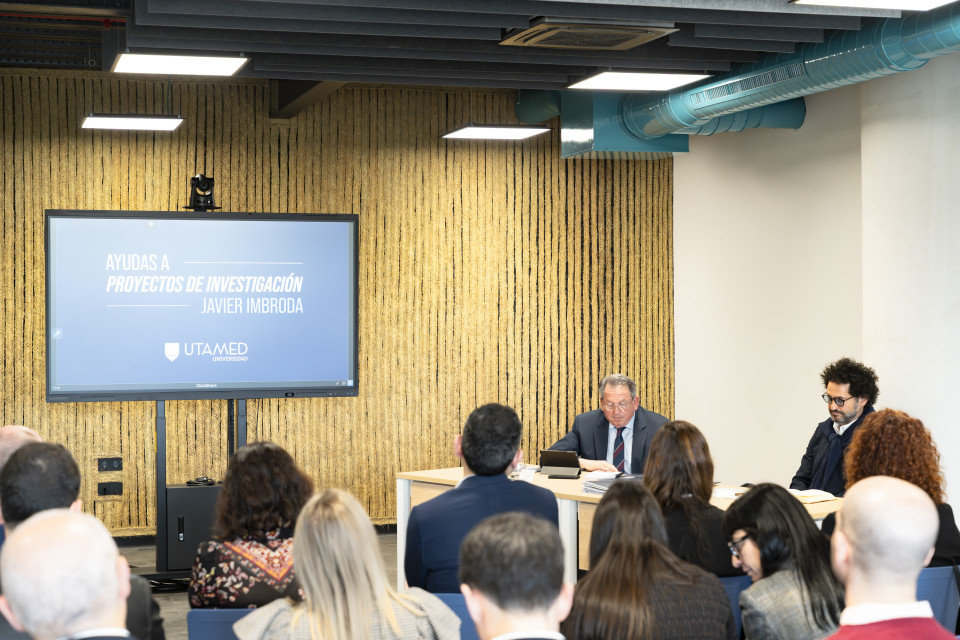
Javier Imbroda Research Project Grants
A UTAMED initiative aimed at promoting high-quality scientific research by supporting innovative projects with social, economic and academic impact. Through this call for proposals, the university reinforces its commitment to knowledge generation and collaboration between researchers from universities and public and private research organisations.
These grants provide funding for the development of basic or applied research projects, promoting research excellence, the transfer of results and the creation of synergies with UTAMED’s teaching and research staff. An opportunity to transform ideas into projects with a real impact and to actively contribute to the advancement of society through research.
The 3 Pillars of Research at UTAMED University
Scientific integrity
Research at UTAMED University is conducted according to principles of integrity, honesty, and academic responsibility. The university promotes best practices throughout the research process and rejects data manipulation, plagiarism, and any conduct that could compromise the quality or transparency of results.
This commitment also extends to the responsible management of conflicts of interest, authorship, and the evaluation of scientific output, reinforcing confidence in the research carried out by the university.
Internationalization
Internationalization is an essential part of UTAMED's research strategy. The university promotes mobility, participation in conferences and academic networks, and collaboration with researchers and institutions at both the national and international levels.
These initiatives foster scientific partnerships, attract funding, and raise the profile of UTAMED University's research, while also contributing to the professional development of its faculty.
Knowledge transfer and impact
UTAMED University is committed to research whose results create value for society and the business community. To that end, it promotes contracts, endowed chairs, joint projects, and other forms of collaboration that facilitate knowledge transfer.
The connection between research and industry makes it possible to put knowledge into practice, develop innovative solutions, and generate new opportunities for entrepreneurship and spin-offs. In this way, the university strengthens its role as an active agent of transformation.
7 Research Support Programs at UTAMED University
1. Talent Support Program: Recruitment and Training
A program that fosters research talent from the earliest stages of an academic career while also attracting experienced professionals who contribute to the growth of research at the university, supporting career development at every stage.
The program comprises several subprograms:
- Predoctoral and postdoctoral training.
- Recruitment and retention of senior talent.
- Faculty career support.
- The Plan Acredita , designed to help faculty obtain accreditation.
- The Plan Consolida , aimed at senior researchers pursuing accreditation as Associate Professor or Full Professor.
2. Program for Building Research Structures and Administrative Support
This program is designed to facilitate research activity and reduce some of the administrative burden associated with it, including:
- Reducing bureaucratic workloads related to accreditations, six-year research assessments, research projects, and high-impact publications.
- Creating and consolidating competitive research groups.
- Advancing the Units of Excellence.
3. Research Development Support Program
UTAMED University offers a system of grants for teaching and research staff that recognizes their research activity, encourages their participation in competitive projects, and promotes high-quality scientific output as well as the gradual development of leadership responsibilities.
This support takes the following forms:
- Research preparation.
- Grants and recognition for research excellence.
4. Knowledge Generation Program: "Projects"
This program drives the development of new research projects through annual calls open to researchers at both public and private institutions.
Its main initiatives include:
- The "Javier Imbroda" Projects.
- Support for submitting proposals to external competitive calls.
5. Internationalization and Mobility Program
Research also advances through exchange and collaboration with other institutions. To that end, UTAMED University encourages mobility and participation in international initiatives as a way to expand networks, secure funding, and access new projects.
This area includes:
- Short-term stays and international mobility.
- Support for participation in European networks, projects, and consortia.
- Visiting Scholars.
6. Knowledge Transfer and Impact Program
This program works to ensure that the knowledge generated at the university has practical applications and reaches both society and the business community. To that end, it promotes various avenues of collaboration and transfer, along with initiatives designed to raise the visibility of the university's research, such as:
- Endowed chairs and research contracts.
- UTAMED Spin-Off.
7. Grant Program for the Acquisition and Maintenance of Scientific Equipment
Research activity requires adequate resources and materials in order to move forward. This program supports the acquisition and maintenance of the research infrastructure and scientific equipment needed for UTAMED University's research projects.